SLIDE 02 / 18
Why this matters
You are the coordinator of your own care
Click the slide to open it full size.
From the talk
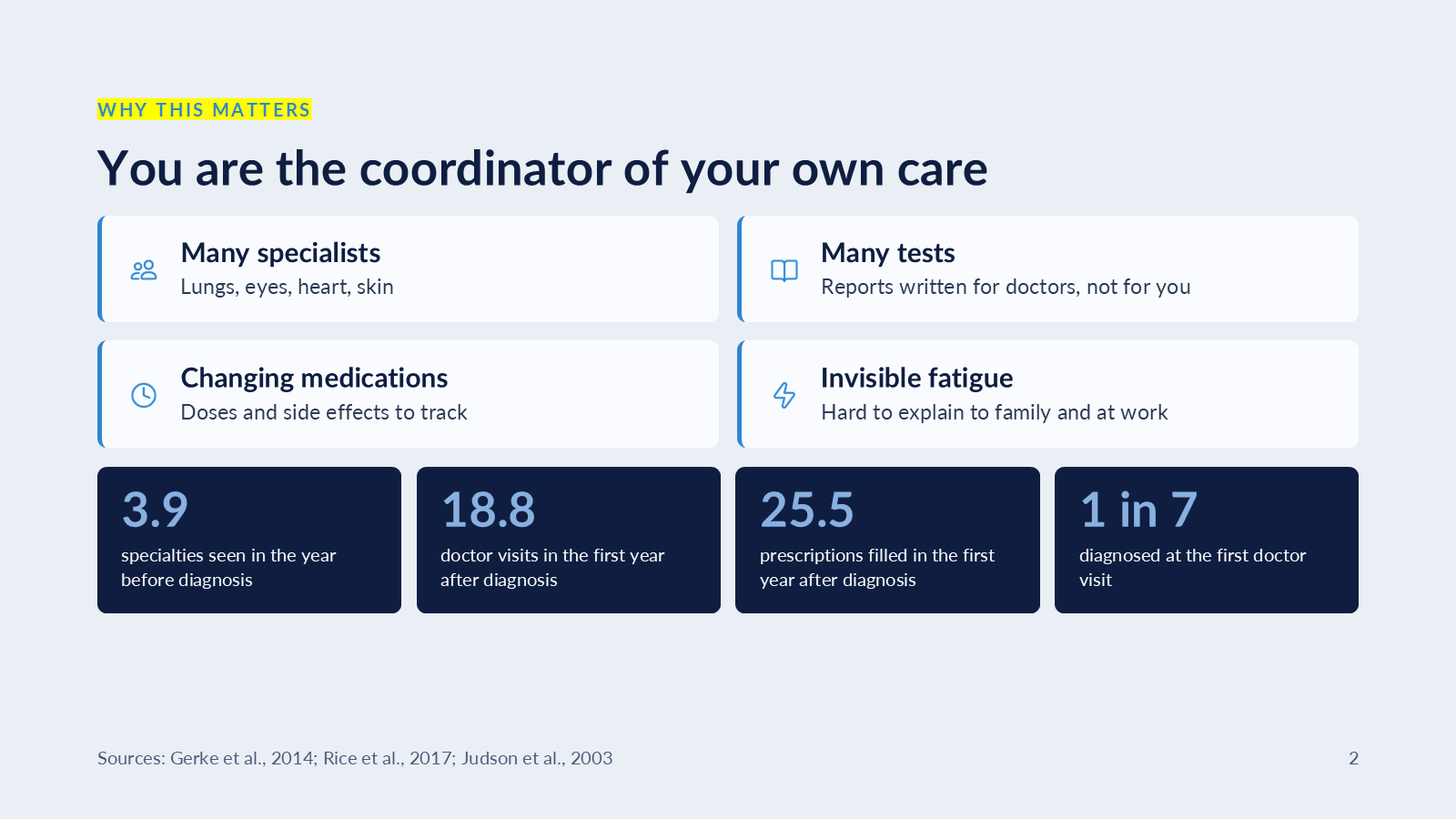
If you live with sarcoidosis, you are already doing a job nobody trained you for. You see a lung doctor, an eye doctor, maybe a cardiologist or a dermatologist. You get breathing tests, scans, and blood work.
Your medications change. And the fatigue is real, but nobody can see it. The numbers show it starts even before diagnosis.
In the year before they were diagnosed, people with sarcoidosis averaged almost 15 doctor visits and close to 4 different specialties, about twice as much as people with other lung conditions like asthma or COPD (Gerke and colleagues, 2014). And only about 1 in 7 were diagnosed at their very first visit (Judson and colleagues, 2003). After diagnosis, the visits keep coming.
In the first year after diagnosis, people with sarcoidosis averaged almost 19 doctor visits and filled about 25 prescriptions, more than matched patients without sarcoidosis. They were also far more likely to see specialists: 38 percent saw a lung doctor, compared with 5 percent, 29 percent saw an eye doctor, compared with 15 percent, and 13 percent saw a rheumatologist, compared with 3 percent (Rice and colleagues, 2017, a study of more than 7,000 patients). The most common treatment is prednisone, followed by methotrexate.
One note so I am accurate: 25 prescriptions filled does not mean 25 different medicines. One medicine refilled every month counts as 12. AI cannot do this job for you, but it can help you carry it.
A little about me: I have been the nurse, the caregiver, and the patient, so I know this from every side.
Read the slide as text
- Many specialists
- Many tests
- Lungs, eyes, heart, skin
- Reports written for doctors, not for you
- Changing medications
- Invisible fatigue
- Doses and side effects to track
- Hard to explain to family and at work
- 3.9
- 18.8
- 25.5
- 1 in 7
- specialties seen in the year before diagnosis
- doctor visits in the first year after diagnosis
- prescriptions filled in the first year after diagnosis
- diagnosed at the first doctor visit
- Sources: Gerke et al., 2014; Rice et al., 2017; Judson et al., 2003
Tip: use the ← and → keys to move between slides.